
Article: Training jacket review for women: what decides the fit
Training jacket review for women: what decides the fit
A training jacket review for women says more about everyday life than about the fitting room. The jacket should stay put when you raise your arms, feel as natural on the way home as during the warm-up, and hold its shape after thirty washes. Those are the three things you measure. The rest is taste.
We design jackets for the female body in motion, and we know where they fail when they fail: across the shoulders, at the waist and at the zip. This is what we check ourselves before a jacket earns a place in Training Jackets.
What should a training jacket review for women test?
Start at the shoulders. Raise your arms straight up. Does the whole jacket follow, or does the hem stay where it should? A jacket that rides up with every press is one you will adjust all session, and in the end you take it off.
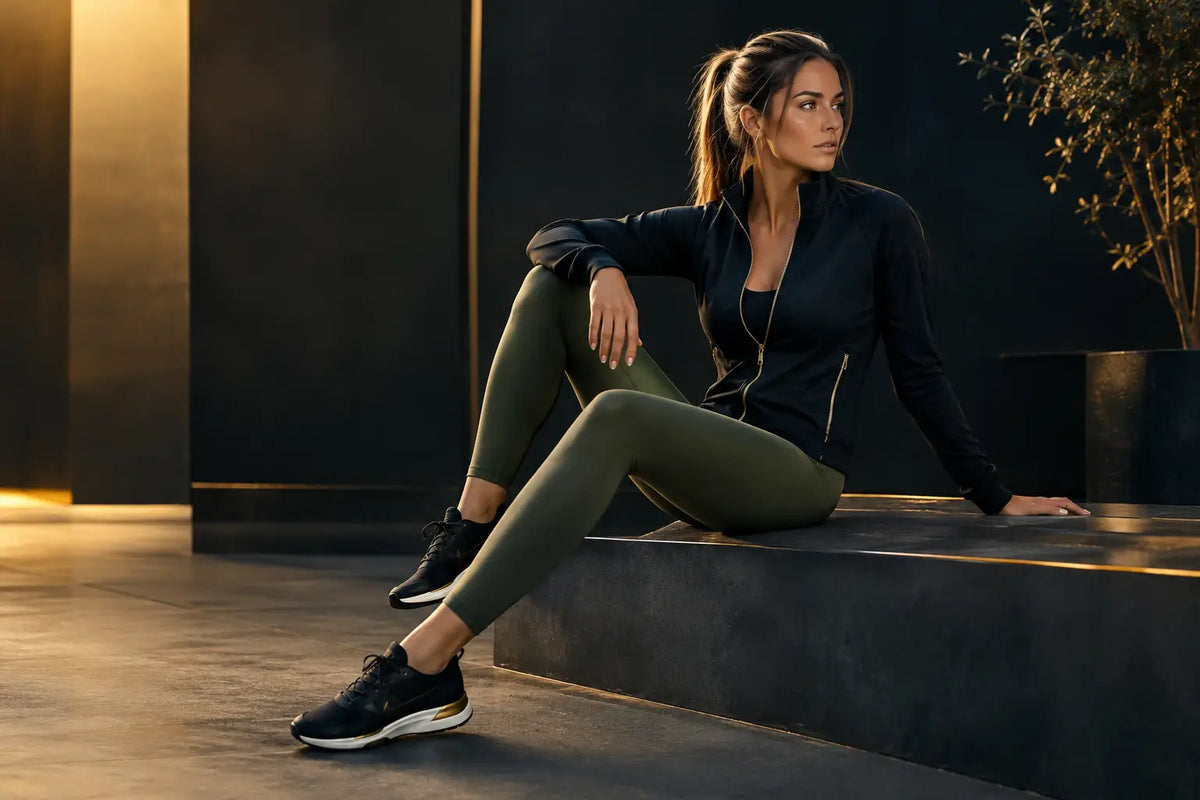
Then go to the waist. That is where the silhouette is decided. A wide elastic ribbed waistband holds the jacket in place and lets the lower back and waist come forward at once, while a straight hem falls softer and reads looser. Iconic Training Jacket G2 is designed on exactly that contrast: snug at the waistband, loose through the torso. The sculpting effect comes from the waistband, not from the whole jacket sitting tight.
Last, try the zip. Close it all the way up. If the fabric creases over the bust, the size or the style is wrong for you. If the zip lies flat and the collar feels soft against your neck, you have a jacket you will actually close on a cold morning.
Which size should you try first?
Try your usual size. A close-fitting training jacket should feel yielding across chest, back and arms, not tight. If you often wear a thicker layer underneath, size up rather than choose a style that pulls across the shoulders.
Cuffs are easy to overlook. They should stay put without pressing at the wrist. Thumbholes are useful outdoors through the dark months, less so at the office. A plain cuff moves more freely between the session and the rest of the day.
The fabric: what are you feeling for?
Pull the fabric gently and let go. A good performance fabric returns without going slack. Feel the inside too. It should be comfortable straight against the skin, because that is where the jacket is worn when it is warm.
Weight is a choice, not a measure of quality. A denser fabric gives a sharper line and works better as an outer layer. A lighter one breathes more through intense sessions, but shows every crease. Edge Black Training Jacket is sewn in recycled ECO Circle polyester with 4-way stretch, moisture-repellent and quick-drying, with faux leather details that give it an edge performance pieces rarely have.
The wash routine is part of the test. Follow the care label, wash with similar colours and keep the temperature down. Fabric softener can settle in performance fibres and make the fabric less breathable, so use it with thought. Clothing that is cared for properly keeps its fit, colour and surface considerably longer.
The details that decide whether the jacket gets worn
Pockets should sit where you can reach them. Zip side pockets hold a key, a card and headphones on the walk. More pockets than that add volume to a clean front without contributing anything. For the gym, a smooth front and the bag by the bench are usually enough.
Collar, length and colour are where taste comes in. A shorter jacket meets high-waisted tights without a gap. A slightly longer back sits better under a backpack and on the move. Gold-coloured zips and details, as in Goldline, read more as jewellery than as sports trim and make the jacket easier to wear with jeans.
Reflective detail is a clear example of use deciding the choice. It is worth a great deal if you move outdoors at dusk, and almost nothing if you train indoors and want a quiet look.
From the session into the rest of the day
The most useful jacket does not have to do everything. It has to do what you need. If you train strength, you prioritise a stable fit and stretch across the shoulders. If you walk long distances in the cold, the collar, the length of the back and the room for layers weigh heavier. If you wear the jacket day to day and on the plane, the smooth surface and the clean hems are what decide.
If you want to go deeper into the individual details before buying, there is How to choose a training jacket: seven details that decide.
Try it at home, with the tights, tops and shoes you wear most. Sit down. Reach your arms up. Close the zip. If after a while you forget you have the jacket on, the test is passed.
Anything but ordinary.

Leave a comment
This site is protected by hCaptcha and the hCaptcha Privacy Policy and Terms of Service apply.