
Article: Yoga tights or gym tights - which should you choose?
Yoga tights or gym tights - which should you choose?
You notice straight away when a pair of tights is not made for the movement you are about to do. The waistband slips in downward dog, the fabric turns sheer in a squat, or the seams chafe as the pace picks up. The question of yoga tights or gym tights is therefore less about the label and more about how you want to move, how you want to feel and how you want to wear the tights before and after training.
For many, the line is not that sharp either. A well designed pair can work just as well for mobility work, strength training and a day in town. The difference sits in the construction: the hand of the fabric, the degree of support, how high the waist is and how seams and panels follow the body in movement.
Yoga tights or gym tights - the movement decides
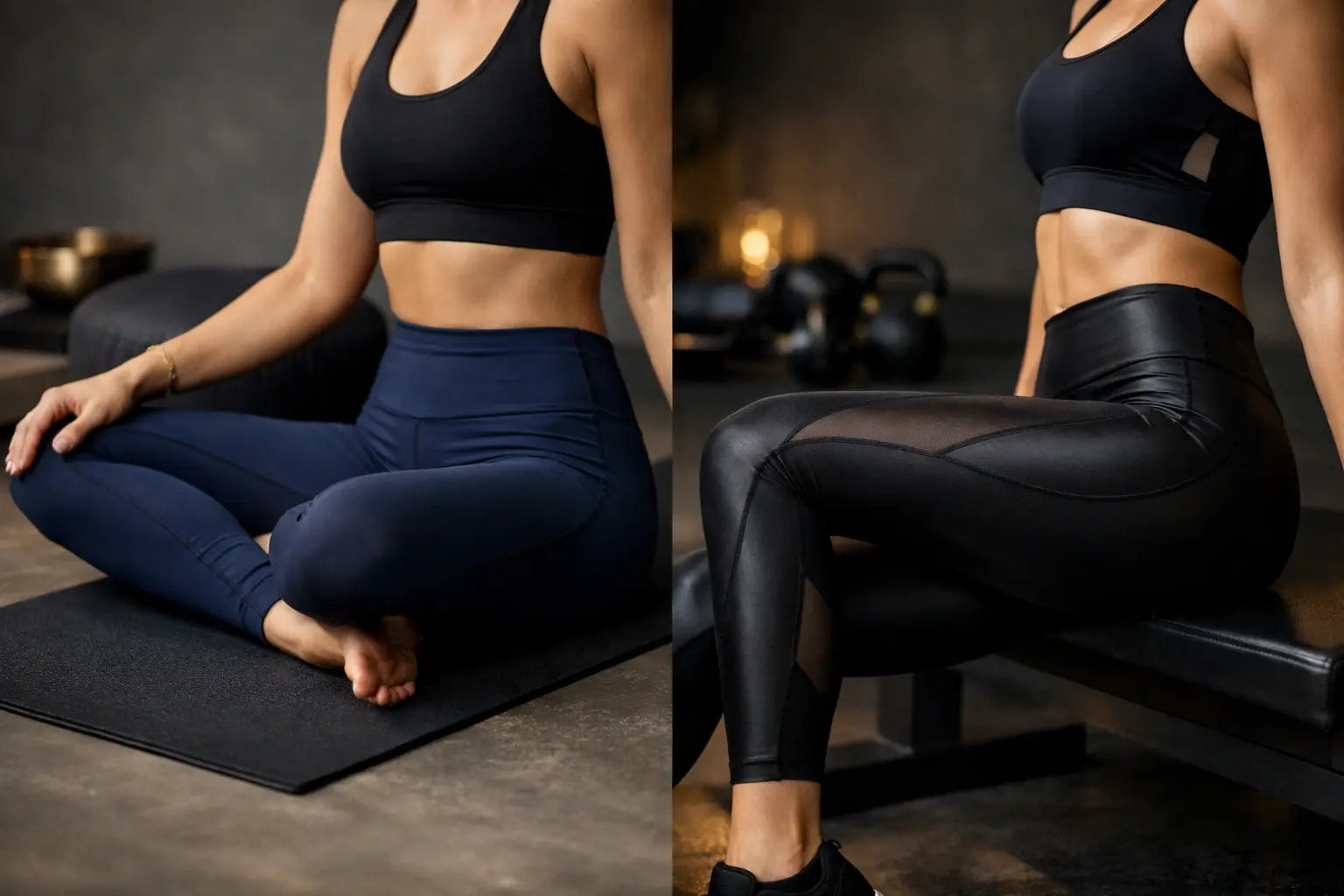
Yoga tights are usually made for calmer, controlled movement. They need to follow you as you open the hip, shift between positions on the mat and hold a longer seated posture. That is why a soft, pliable fabric with few distracting details is often valued. Against the skin it can be close, even and free of unnecessary pressure.
Gym tights often have to handle a different kind of load. Strength training, intervals and machine work mean repeated bending, more friction and movement where the tights have to hold their position. Here, stability at the waist and a fabric with good recovery become central. The material should keep its shape between sets rather than need pulling up after every repetition.
That does not mean yoga tights are always thin or that gym tights have to be firm. A woman who trains reformer, yoga and walking may be happiest in a soft pair with a high waist. Someone who works on mobility after a strength session may want more support on the mat as well. Choose for your most frequent movement, but also for what you actually want to wear the garment for through the rest of the day.
The fabric should give the right feel and control
Fabric is one of the clearest differences between tights that only look good on the hanger and tights that become an obvious choice in the wardrobe. For yoga, a smooth, soft surface can make a real difference. It follows the body without feeling restrictive and suits you when you want to focus on breath, position and flow rather than on the garment.
At the gym you often need a denser quality. A fabric with recovery helps the tights return to shape after squats, lunges and deadlifts. It also gives a steadier feel as you move between exercises. Opacity matters, particularly in light colours or in deep movement, but it should come from considered fabric and construction rather than a stiff material.
Recycled material can be a sound choice when it is combined with durable construction. It is not only fibre content that decides how long a garment lasts, but also how it is cut, sewn and tested for repeated wear. Tights that keep their fit and surface after washing stay useful over time.
Compression is not the same as a good fit
A pair of gym tights can feel firmer, but more compression is not automatically better. If the waistband digs in, the fabric limits the hip in movement or you choose a size you keep wanting to adjust, training becomes less comfortable. The right tights hold you without holding you back.
For yoga, too much compression can make the garment feel unnecessarily technical. For intense sessions, too little support can feel as though the tights lack steadiness. The balance lies in a fabric that follows every movement and a construction that keeps the garment where it should sit.
Fit makes the difference
A high waist is a popular choice for a reason. It gives a collected silhouette, can feel stable in movement and makes it easier to wear the tights with a shorter training top, a t-shirt or a training jacket. But height alone is not enough. The waistband needs to be shaped to lie flat and stay in place, both when you sit on the floor and when you take on load at the gym.
Seam placement matters just as much. Seams positioned to lift the silhouette create direction and shape instead of becoming a decorative afterthought. Shaped side panels can follow the line of the leg and give a more considered look, while a well judged construction helps the garment move with the body.
This is the basis of sculpting tights: design choices that build silhouette through pattern construction, panels and precise lines. The result should feel athletic and feminine, not overworked. Wallderinska works with this kind of sculpting detail to combine a stable fit with a pared back look that carries far beyond the training room.
Test the fit in your own movement
When you try tights on, do not just stand in front of the mirror. Sit down deep, lift a knee, bend forward and take a few steps. The waistband should stay put without rolling. The fabric should not pull across thighs or knees, and the gusset seam should not feel noticeable.
Look at the length as well. Full length tights give a coherent look at the gym, on a walk and under a longer jacket. An ankle length style can be practical for a shorter leg or when you want a lighter feel. There is no universal length - it comes down to proportion, comfort and how you want to style the garment.
When one pair of tights has to work all day
The most useful tights do not stay at home after the session. They come along to the shops, on a journey, through a working day at home or out for a coffee after training. Colour, surface and detail then become at least as relevant as function.
Black and muted, neutral tones are easy to combine with casualwear and outerwear. A matching training jacket gives a clear whole without feeling like a uniform, while a complete set creates a considered silhouette with few decisions. That works particularly well when the day moves from the gym to errands and you want to feel dressed without changing.
For travel, comfort is decisive, but construction counts here too. Tights with a high waist and a fabric that recovers well feel more composed after hours in a car, on a train or on a flight. Add a sculpting jacket with clean lines and you have a set that holds together from terminal to destination.
Choose for the training week, not a single session
If you practise yoga several times a week and value softness, yoga tights may be your first choice. If you often choose strength, functional training or conditioning, gym tights with more steadiness may suit you better. But if your week holds both, a pair of versatile sculpting tights is often the most considered choice.
Then look for a quality that is pliable enough for floor work and stable enough for the gym. A high waist, an opaque fabric and seams with a clear function give you more occasions to wear them without filling the wardrobe with a specialist piece for every activity.
The best choice is the pair you can put on without wondering whether they will stay in place, hold their shape or suit the rest of the day. When fit, fabric and design work together you gain more freedom in movement - and a garment that follows your everyday life with the same precision as your training.

Leave a comment
This site is protected by hCaptcha and the hCaptcha Privacy Policy and Terms of Service apply.